

Imagine having a spiritual mentor who never sleeps, never judges, and is always available the moment you close your eyes.
That’s essentially what a Yidam is — though the reality is far more nuanced and fascinating than this simple description suggests.
If you’ve explored Tibetan Buddhism or browsed collections of Buddhist statues, you’ve likely encountered the term “Yidam” alongside images of deities that range from serene and peaceful to wildly wrathful, adorned with skulls and flames. These aren’t gods to worship in the conventional sense. They’re something far more personal and transformative.
Let’s unravel this profound practice that has shaped Buddhist meditation for over a thousand years.
What Exactly Is a Yidam?
The word “Yidam” comes from Tibetan, roughly translating to “mind deity” or “meditation deity.” But this translation barely scratches the surface.
A Yidam isn’t an external god living on some celestial throne, waiting for your prayers. Instead, it’s a crystallized representation of enlightened qualities that you invite into your consciousness through meditation practice.
Think of it this way: if enlightenment had a face, what would it look like? If compassion could take form, how would it appear? If wisdom could manifest visually, what would you see?
Yidams are the answers to these questions — visual embodiments of the very qualities you’re cultivating within yourself.
Here’s the radical part: in Yidam practice, you don’t just pray to these deities. You become them, if only temporarily, in meditation. You visualize yourself transforming into the Yidam, adopting their posture, their attributes, their enlightened perspective.
It’s less like worship and more like method acting for the soul.
Why Your Brain Loves This Practice
Modern neuroscience is beginning to catch up with what Tibetan practitioners have known for centuries: visualization practice literally rewires your brain.
When you repeatedly visualize yourself as a deity embodying perfect compassion, your neural pathways begin to shift. The qualities you meditate on become more accessible in daily life. It’s not magic — it’s neuroplasticity.
The Yidam serves as a concentrated focal point for transformation. Instead of vaguely trying to “be more compassionate” or “develop wisdom,” you have a specific, detailed template to work with. You know exactly what enlightened compassion looks like because you’ve spent hours visualizing Chenrezig’s serene face and thousand helping hands.
Your subconscious mind responds powerfully to images and symbols. Give it a clear target, and it will move toward that target. The Yidam is that clear target.
The Personal Nature of Yidam Practice
Here’s something that surprises many newcomers: your Yidam is uniquely yours.
While there are hundreds of different Yidams in the Tibetan Buddhist pantheon, practitioners typically work with one primary Yidam throughout their lives — or at least for extended periods. This isn’t chosen casually or by personal preference alone.
Traditionally, a qualified teacher helps select your Yidam based on your personality, challenges, and karmic tendencies. Someone struggling with anger might be given a peaceful deity to cultivate calmness. Conversely, someone who’s too passive might work with a wrathful deity to access necessary fierceness and boundary-setting.
It’s a bit like being prescribed the exact medicine you need, except the medicine is a meditation practice and the illness is your own obscurations to enlightenment.
This personal relationship with your Yidam develops over time. Practitioners often describe feeling a genuine connection, as if the deity is a wise friend who understands them completely. Because in a sense, the Yidam is you — your own enlightened potential taking form.
Peaceful vs. Wrathful: Why Some Yidams Look Terrifying
If you’ve seen statues of wrathful Yidams like Mahakala or Vajrakilaya, you might wonder: why would anyone want to meditate on something that looks like it emerged from a nightmare?
This is where Western and Eastern spiritual aesthetics diverge dramatically.
In Tibetan Buddhism, wrathful deities aren’t evil or demonic. They’re fierce compassion personified. Their terrifying appearance represents the forceful energy needed to cut through deep-rooted delusions, ego attachments, and harmful patterns.
Think of them as spiritual surgeons. Surgery isn’t gentle, but it’s sometimes necessary to heal. A wrathful Yidam provides the concentrated intensity required to destroy stubborn mental afflictions that peaceful methods can’t touch.
The flames surrounding wrathful deities? They burn away ignorance. The skulls and bone ornaments? Reminders of impermanence and the transcendence of death. The fierce expression? The uncompromising nature of truth that destroys all falsehood.
Meanwhile, peaceful Yidams like Tara or Amitabha embody gentler qualities — nurturing compassion, patient wisdom, healing presence. They’re equally powerful, just differently expressed.
Neither is superior. They serve different purposes for different temperaments and different moments on the spiritual journey.
How Yidam Practice Actually Works
The mechanics of Yidam practice might seem complex at first, but the basic structure is elegant:
Visualization Phase
You begin by visualizing the Yidam in front of you — every detail from the color of their body to the implements they hold, the posture they sit in, the expression on their face. Advanced practitioners can hold incredibly detailed visualizations, but beginners start simple.
Transformation Phase
Gradually, you dissolve the visualization in front of you and imagine yourself as the Yidam. You’re no longer your ordinary self with all your limitations and hang-ups. You’re the embodiment of enlightened qualities. You see through the Yidam’s eyes, feel with the Yidam’s heart.
Mantra Recitation
Most Yidam practices include specific mantras — sacred sounds associated with that deity. As you hold the visualization and sense of being the Yidam, you recite these mantras, deepening the experience. The sound vibrations reinforce the transformation.
Dissolution and Integration
At the end of the session, you gradually dissolve the visualization, but you don’t return completely to ordinary perception. You carry the blessing and energy of the practice into daily life. Over time, the qualities cultivated in meditation begin appearing spontaneously in your regular interactions.
Common Yidams and What They Offer
While there are countless Yidams, some are particularly widespread in practice:
Chenrezig (Avalokiteshvara)
The embodiment of universal compassion, usually visualized as white and radiating loving kindness. Chenrezig practitioners develop genuine care for all beings and the ability to respond skillfully to suffering. This is often recommended as a foundational practice.
Tara
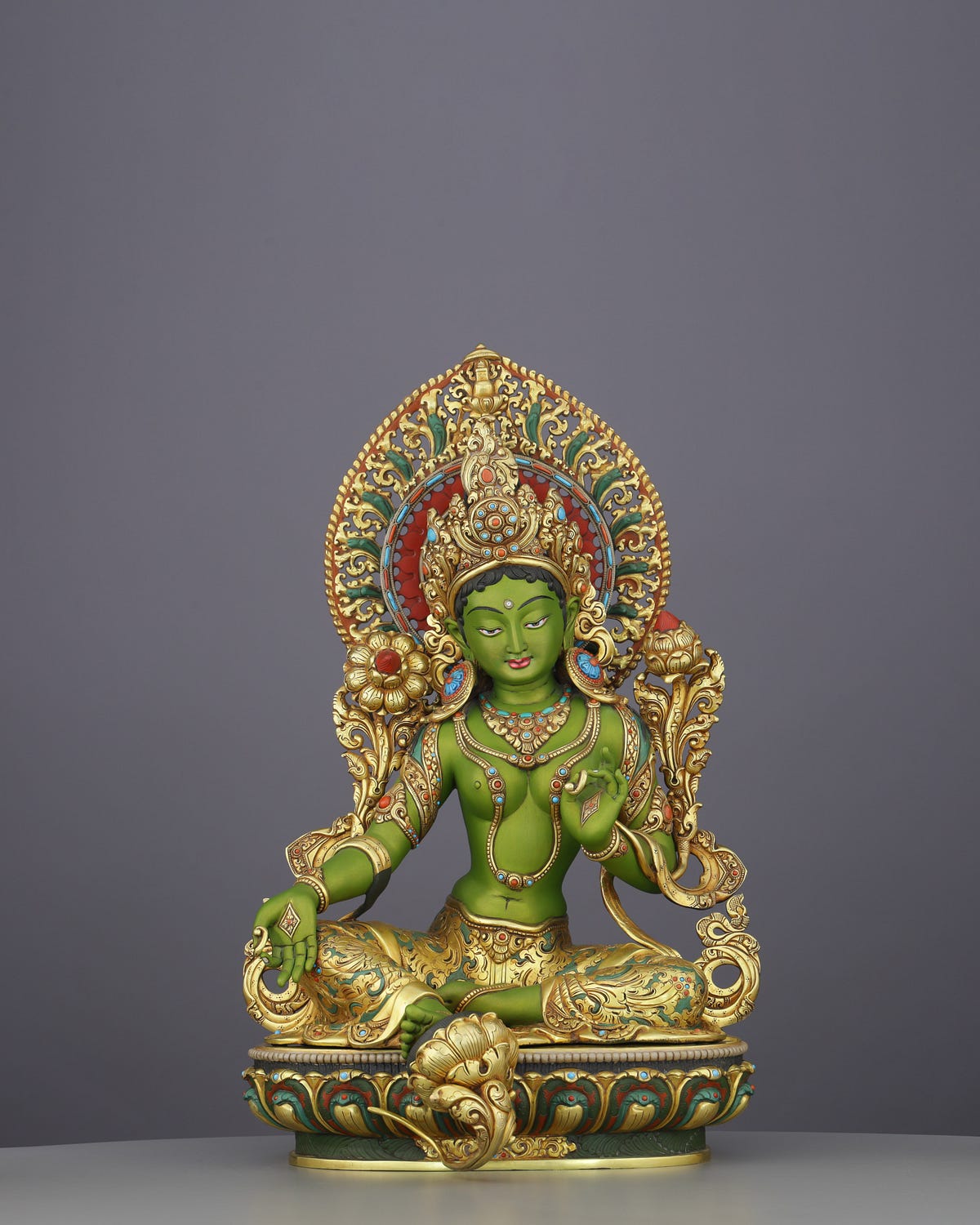
The female Buddha of swift compassionate action, usually green or white. Tara represents enlightened activity and the ability to quickly respond to needs. Practitioners report developing courage, resourcefulness, and protective energy.
Manjushri
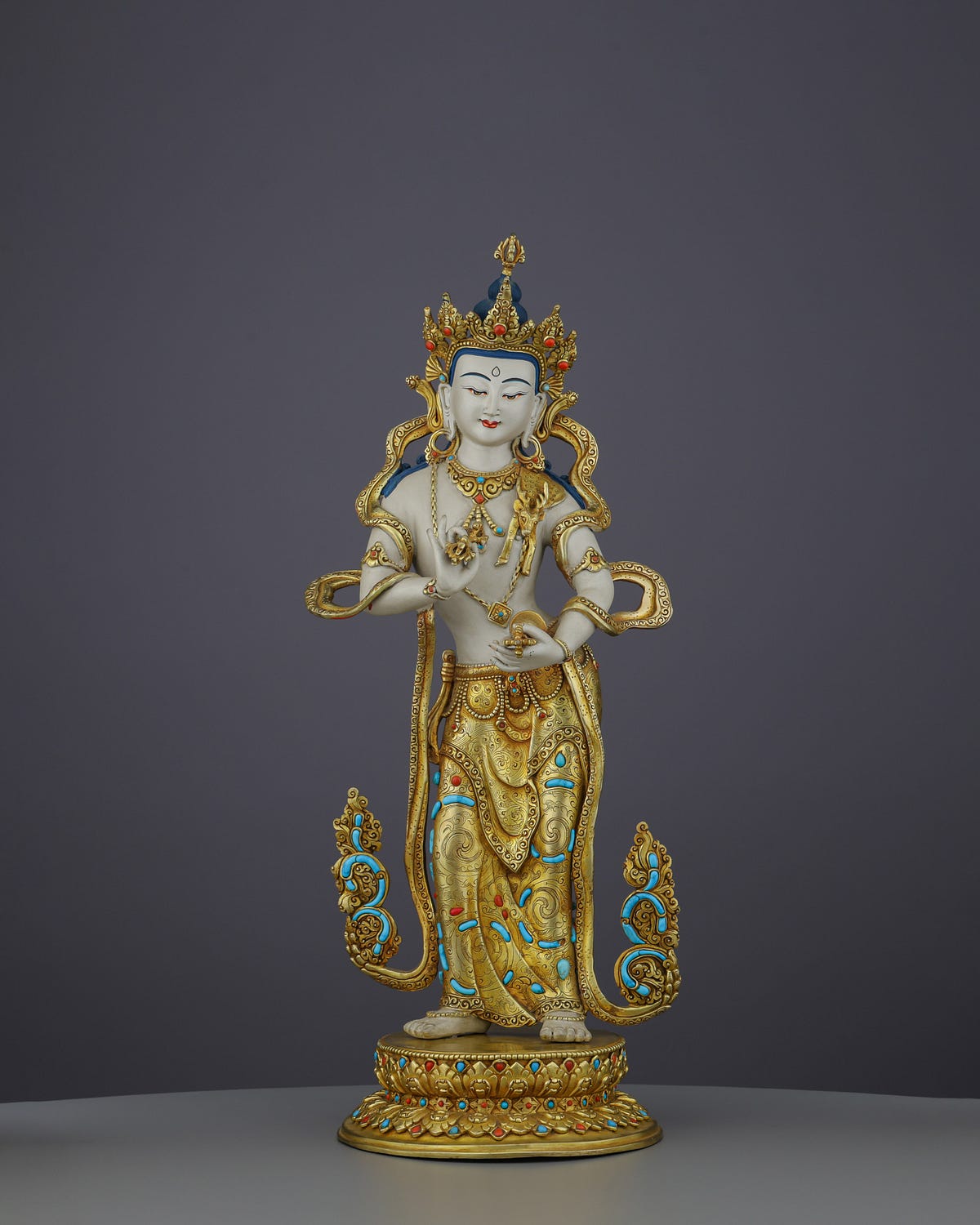
The deity of wisdom, visualized as orange or golden, holding a flaming sword that cuts through ignorance. Manjushri practice sharpens intellect, enhances learning, and develops discriminating wisdom.
Vajrasattva
The purification deity, brilliant white and holding a vajra and bell. This practice specializes in clearing karmic obscurations and healing past harm, both committed and received.
Mahakala
A powerful wrathful protector, usually deep blue or black, with fierce ornamentation. Mahakala helps practitioners overcome obstacles, develop fearlessness, and protect their spiritual progress from interference.
Each Yidam is like a complete curriculum for developing specific enlightened qualities.
The Statue Connection: Why Physical Images Matter
This brings us to why Yidam statues hold such importance for practitioners.
A well-crafted statue isn’t mere decoration — it’s a meditation support tool. When you’re learning to visualize your Yidam, having a physical representation helps tremendously. Your eyes can study every detail: the curve of the fingers in a mudra, the exact arrangement of ornaments, the subtle expression conveying both power and peace.
Many practitioners keep a statue of their Yidam on their meditation altar as a focal point. Before closing their eyes to visualize, they study the statue, allowing the image to imprint on their mind. Over time, the external image and internal visualization merge.
The quality of the statue matters because you’re using it as a template for mental transformation. A finely detailed, proportionally accurate statue makes the visualization practice more effective. It’s why serious practitioners invest in authentic, well-crafted pieces rather than mass-produced replicas.
What Yidam Practice Isn’t
To clear up common misunderstandings:
It’s not idol worship. You’re not praying to an external deity for favors. You’re using the deity form as a transformational tool.
It’s not cultural appropriation if approached correctly. When practiced with proper instruction, respect, and genuine commitment to the underlying philosophy, Yidam practice is available to sincere practitioners regardless of cultural background.
It’s not escapism or fantasy. The goal isn’t to pretend you’re something you’re not. It’s to recognize and actualize the enlightened potential that’s already within you.
It’s not a quick fix. Yidam practice is traditionally undertaken for years or even a lifetime. It’s a gradual, cumulative transformation, not an instant awakening hack.
Integration: Bringing Your Yidam Into Daily Life
The real test of Yidam practice isn’t how vividly you can visualize in meditation. It’s whether the qualities you’re cultivating actually manifest when you need them.
When someone cuts you off in traffic, can you access Chenrezig’s patience? When faced with a complex problem, can you tap into Manjushri’s wisdom? When someone you love is suffering, can you embody Tara’s swift compassion?
Advanced practitioners report that over time, the boundary between “meditation deity” and “ordinary self” becomes pleasantly blurred. The enlightened qualities stop being something you access only on the cushion and become part of your default operating system.
You’re not trying to walk around constantly visualizing yourself as a deity. That would be exhausting and odd. Instead, the practice subtly shifts your baseline consciousness. You become more naturally compassionate, wise, or courageous — whatever your Yidam specializes in.
Finding Your Yidam: Where to Begin
If you’re intrigued by Yidam practice, the traditional path is clear: find a qualified teacher in the Vajrayana Buddhist tradition.
Yidam practice typically requires empowerment (wang or abhisheka) from an authorized teacher. This isn’t gatekeeping — it’s ensuring you have proper instruction in what can be a subtle and powerful practice. The teacher provides the transmission of the practice, detailed guidance, and ongoing support.
That said, you can begin exploring:
Study different Yidams. Learn their qualities, stories, and what they represent. Notice which ones resonate with you and why.
Develop basic visualization skills. Simple meditation on sacred images — even without formal Yidam practice — builds the mental muscles you’ll need later.
Consider your spiritual needs. What qualities do you most need to develop? Where are your biggest obstacles? These questions can guide you toward the right practice when you’re ready.
Respect the tradition. Approach with humility and genuine interest in the underlying philosophy, not just fascination with exotic imagery.
The Timeless Relevance of This Ancient Practice
In our modern world of infinite distractions and fractured attention, Yidam practice offers something increasingly rare: a coherent, time-tested method for deep personal transformation.
We’re constantly bombarded with messages about who we should be, what we should buy, how we should look. The noise is overwhelming. Yidam practice offers the opposite — a clear, focused, internally-directed path toward becoming your highest self.
The deities haven’t changed in centuries, but their relevance remains fresh because human challenges remain fundamentally the same. We still struggle with anger, confusion, fear, and self-centeredness. We still yearn for wisdom, compassion, peace, and awakening.
Your Yidam is waiting — not on some heavenly plane, but within your own consciousness, ready to emerge the moment you begin the practice.
The Mirror That Transforms You
Ultimately, your Yidam is a mirror showing you what you can become.
When you gaze at that statue on your altar or hold that visualization in meditation, you’re not looking at something separate from yourself. You’re seeing your own enlightened potential given form, color, and expression.
The deity’s compassion is your compassion, fully realized. The deity’s wisdom is your wisdom, unclouded. The deity’s power is your power, unobstructed.
Yidam practice is the profound art of closing the gap between who you are and who you have the capacity to become — one visualization, one mantra, one moment of transformed awareness at a time.
The question isn’t whether you have Buddha nature within you. Buddhism insists you do.
The question is: are you ready to give it a face, cultivate it deliberately, and allow it to transform everything?


