

There’s a question that quietly unsettles many Western practitioners the first time they encounter it, usually in a monastery gift shop, or while browsing a Himalayan art gallery, or the moment they stumble upon a rotund, jewel-adorned deity clutching a mongoose that spits gems from its mouth.
Who is this? And what is he doing in a Buddhist tradition that preaches non-attachment?
The deity is Dzambhala (also written Jambhala or Zambhala), the Buddhist God of Wealth. And the confusion surrounding him reveals something profound, not just about Buddhist philosophy, but about how we in the modern world fundamentally misunderstand what poverty and prosperity really mean.
The Contradiction That Isn’t
Buddhism, as most people understand it, teaches non-attachment. Let go of desire. Release your grip on material things. The path to liberation is inward, not outward.
So how does a wealth deity fit into all of this?
The answer lies in a distinction the tradition has always been careful to make — one that gets lost in translation when Buddhism travels from the Himalayas to the West.
Buddhism does not say wealth is evil. It says attachment to wealth and the anxiety produced by its absence, is what causes suffering.
There’s a world of difference between those two ideas. And Dzambhala lives precisely in that gap.
Who Is Dzambhala?
In the Vajrayana Buddhist tradition, the lineage flourished across Nepal, Tibet, and Bhutan. Dzambhala is one of the Eight Auspicious Deities and the foremost protector against material poverty. He appears across multiple forms, the most well-known being Yellow Dzambhala, though the tradition recognizes five principal emanations: Yellow, White, Black, Green, and Red, each corresponding to a different buddha family and approach to prosperity.
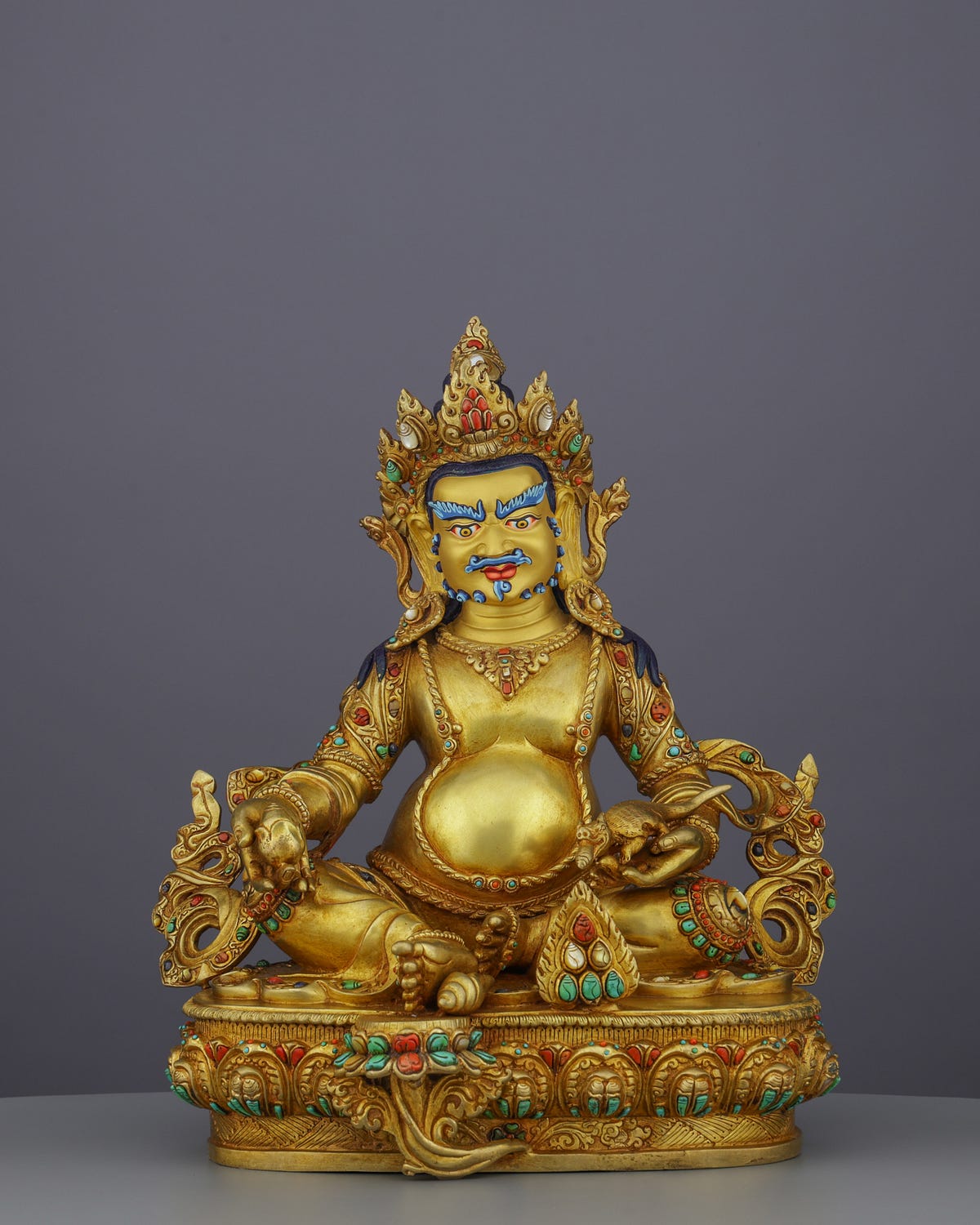
His iconography is unmistakable:
- A rotund, powerful body — not laziness, but fullness, abundance, the earth’s generosity made visible
- A jewel-spitting mongoose held in his left hand — the nehulay, a creature believed to have dominion over nagas (serpent spirits associated with underground treasures)
- A wish-fulfilling jewel (chintamani) in his right hand
- Richly adorned with ornaments, seated in royal ease upon a lotus throne
He is sometimes depicted trampling upon Shiva, not as an act of conquest, but as a symbol of mastery over the ego, over the illusion that we are separate from abundance.
The Mongoose and the Treasure
The mongoose in Dzambhala’s hand is perhaps his most distinctive, and most misread symbol.
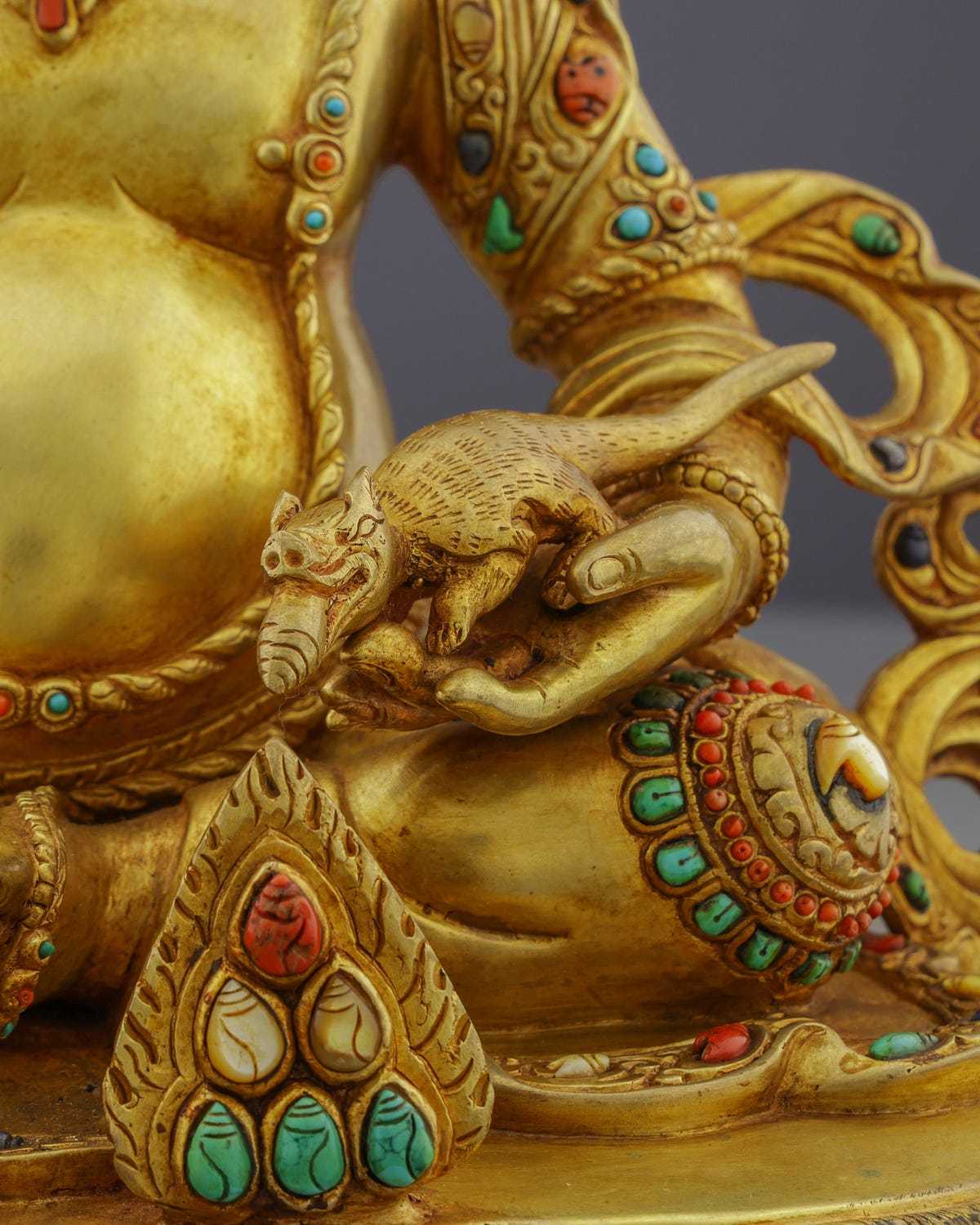
In ancient Indian lore, the mongoose is the natural enemy of the naga serpents who guard buried treasure. But in Buddhist iconography, it goes deeper: the mongoose vomits jewels, it overflows with wealth. It doesn’t hoard. It gives. Endlessly.
This is the teaching encoded in the image: true wealth is not what you accumulate, it is what flows through you and out into the world.
Dzambhala is not the deity of stockpiling. He is the deity of generosity made possible. Of giving without depletion. Of a stream that never runs dry.
What Dzambhala Actually Dissolves
Here is the heart of it, the thing that changes everything once you understand it.
Poverty is not simply a material condition. It is also a psychological and spiritual condition. In the Vajrayana view, the experience of scarcity — the grinding anxiety of “not enough,” the mental noise of financial fear, the way money-worry colonizes the mind — is one of the greatest obstacles to genuine spiritual practice.
You cannot meditate when you are terrified about rent. You cannot cultivate compassion when desperation has closed your heart. You cannot walk the Bodhisattva path — the path of helping all beings — when you have nothing to give.
Dzambhala does not exist to help you accumulate luxury. He exists to dissolve the anxiety of poverty so that practitioners can focus entirely on their spiritual path and have the resources to help others.
This is why in Vajrayana monasteries across Nepal and Tibet, Dzambhala practices are taken seriously, not as materialistic indulgence, but as a form of merit-work. Clearing the obstacles to generosity. Removing the impediments to practice. Creating the conditions in which the Dharma can actually flourish.
The Merit Economy: Wealth as a Spiritual Tool
To understand Dzambhala fully, one must understand the Buddhist concept of merit (punya).
In the Himalayan Buddhist worldview, material prosperity is not random. It is the fruition of past virtuous actions — acts of generosity, compassion, and devotion that “planted seeds” ripening into present-day abundance. Wealth, in this view, is a form of karma made visible.
This means several important things:
1. Wealth carries responsibility. If prosperity is the fruit of merit, then hoarding it stops the cycle. The tradition is explicit: wealth that flows into generosity generates more merit; wealth that is clutched tightly creates the karmic conditions for future poverty.
2. Praying for wealth is praying for the capacity to give. Dzambhala sadhana, the practice surrounding the deity — isn’t just a petition. It involves visualization, mantra recitation, and crucially, the aspiration to use whatever wealth arrives for the benefit of all beings. Without that aspiration, the practice is incomplete.
3. Spiritual practice requires material support. The Buddha himself accepted alms. Monasteries require funding. Teachers need to eat. Art — the sacred statues, thangkas, and ritual objects that transmit the Dharma visually — requires skilled artisans and material investment. Dzambhala supports this entire ecosystem.
The Five Dzambhalas: A Map of Abundance
The tradition offers five emanations of Dzambhala, each corresponding to one of the Five Buddha Families and their particular energetic quality:
Yellow Dzambhala — the most widely practiced form, associated with the Ratnasambhava Buddha family and the element of earth. He is the most directly concerned with dissolving material poverty and is the form most commonly encountered in Nepalese and Tibetan households.
White Dzambhala — associated with Chenrezig (Avalokiteshvara), the Bodhisattva of Compassion. His wealth practice is inseparable from compassion; he is invoked specifically for the relief of suffering born from poverty.
Black Dzambhala — a wrathful emanation, fierce in appearance, who cuts through obstacles and negative karma with particular power. Often propitiated for urgent, severe circumstances.
Green Dzambhala — connected to the energy of karma and swift action, often invoked for unexpected windfalls and the rapid removal of financial obstacles.
Red Dzambhala — the most esoteric of the five, associated with magnetizing energy and the amplification of influence. Less commonly practiced outside initiatory contexts.
Each form is a different medicine for a different condition. The tradition’s sophistication lies in this recognition: that prosperity has multiple dimensions, and different obstacles require different approaches.
His Mantra: Sound as Transmission
Dzambhala’s mantra is among the most widely recited wealth mantras in the Vajrayana world:
Om Dzambhala Dzalendraye Soha
(Tibetan tradition)
Or in its longer Sanskrit form:
Om Jambhala Jalendraye Svaha
The mantra invokes Dzambhala by name and affirms his sovereign power (jalendraye — “lord of wealth”) before the offering syllable soha/svaha — a Sanskrit term of offering and completion.
Traditional practice involves reciting this mantra while visualizing Dzambhala above the crown of the head, golden light radiating from him and filling the body and surroundings. The mongoose in his hand overflows with gems, and the practitioner aspires that this abundance flows outward to benefit all beings in all directions.
This is not wish-fulfillment magic. It is a structured contemplative practice designed to shift the mind’s relationship to scarcity — from anxiety to openness, from grasping to generosity.
Dzambhala in the Living Tradition of Patan
Here at VajraIcon, we are based in Patan, Nepal — one of the ancient Newar cities of the Kathmandu Valley, a place where the tradition of crafting Buddhist sacred statuary has been unbroken for over a thousand years.
Dzambhala statues are among the most beloved works our Newari artisans produce. They are crafted using the ancient lost-wax casting method (cire perdue), a technique passed down through generations of metalsmithing families in Patan’s traditional workshops.
These are not decorative objects. They are pratimas — sacred representations intended to serve as supports for practice. A Dzambhala statue placed on a home altar is a visual reminder, a focal point for aspiration, and — for those who have received the relevant teachings — a support for formal practice.
Every statue we offer is made by artisans who understand this. The sacred and the aesthetic are not separate in their work. They never have been.
So, Can a Buddhist Pray for Wealth?
Yes. With intention. With aspiration. With the understanding that what you are really asking for is freedom from the suffering that scarcity causes — and the capacity to be more generous, more supportive of Dharma, more able to help others.
The tradition doesn’t condemn the desire for prosperity. It redirects it, toward something larger than personal comfort. Dzambhala is the deity who holds that redirection. Who reminds us that abundance, rightly understood, is not an end but a means.
A means to practice. A means of generosity. A means to the liberation of all beings, including ourselves.
Bringing Dzambhala Into Your Home
If you feel drawn to Dzambhala’s energy, to his warmth, his fullness, his overflowing mongoose, a traditionally crafted statue can serve as a powerful anchor for daily intention.
At VajraIcon we offer Dzambhala statues handcrafted by master Newari artisans in Patan, Nepal. Each piece is made using centuries-old techniques: lost-wax casting, hand-finishing, and fire gilding. These are not mass-produced objects. They are living continuations of a sacred craft tradition.


