

Picture this: A celestial being watches humanity struggle with suffering, fear, and ignorance. Moved to tears, Avalokiteshvara — the Bodhisattva of Compassion — weeps. From his right eye falls a white tear, from his left, a green one. These tears touch the earth and transform into two luminous goddesses who make an extraordinary vow: to liberate all beings from suffering.
This is how Tara was born — not in myth alone, but in the hearts of millions who have sought her protection for over a thousand years.
Who Is Tara?
Tara (meaning “star” or “she who ferries across”) is one of the most beloved goddesses in Tibetan Buddhism and broader Vajrayana traditions. Unlike many deities who remain distant and untouchable, Tara is known as the “mother of liberation” — immediate, accessible, and fiercely protective.
But here’s where it gets fascinating: Tara doesn’t appear in just one form. She manifests as twenty-one distinct emanations, each addressing specific human fears, obstacles, and aspirations. Think of her as a cosmic emergency response team, with each Tara specializing in different crises of the human condition.

The Sacred Geometry of Twenty-One
Why twenty-one? In Tibetan Buddhist cosmology, this number holds profound significance. It represents completeness — seven directions of space times three (past, present, future), or three jewels (Buddha, Dharma, Sangha) times seven chakras. But beyond numerology, the 21 Taras embody a practical truth: human suffering comes in many forms, and so must compassion.
The most famous prayer to the 21 Taras, “The Praises to the Twenty-One Taras,” was revealed by the sage Atisha in the 11th century after a vision. Each verse invokes one Tara, describing her unique qualities and powers. Practitioners recite this prayer to receive protection, overcome obstacles, and accelerate their spiritual journey.
Meet the Sisters: The 21 Forms of Tara
While all 21 Taras deserve attention, let’s explore them all — the faces you’ll encounter in temples, thangka paintings, and meditation practices across the Himalayan world.
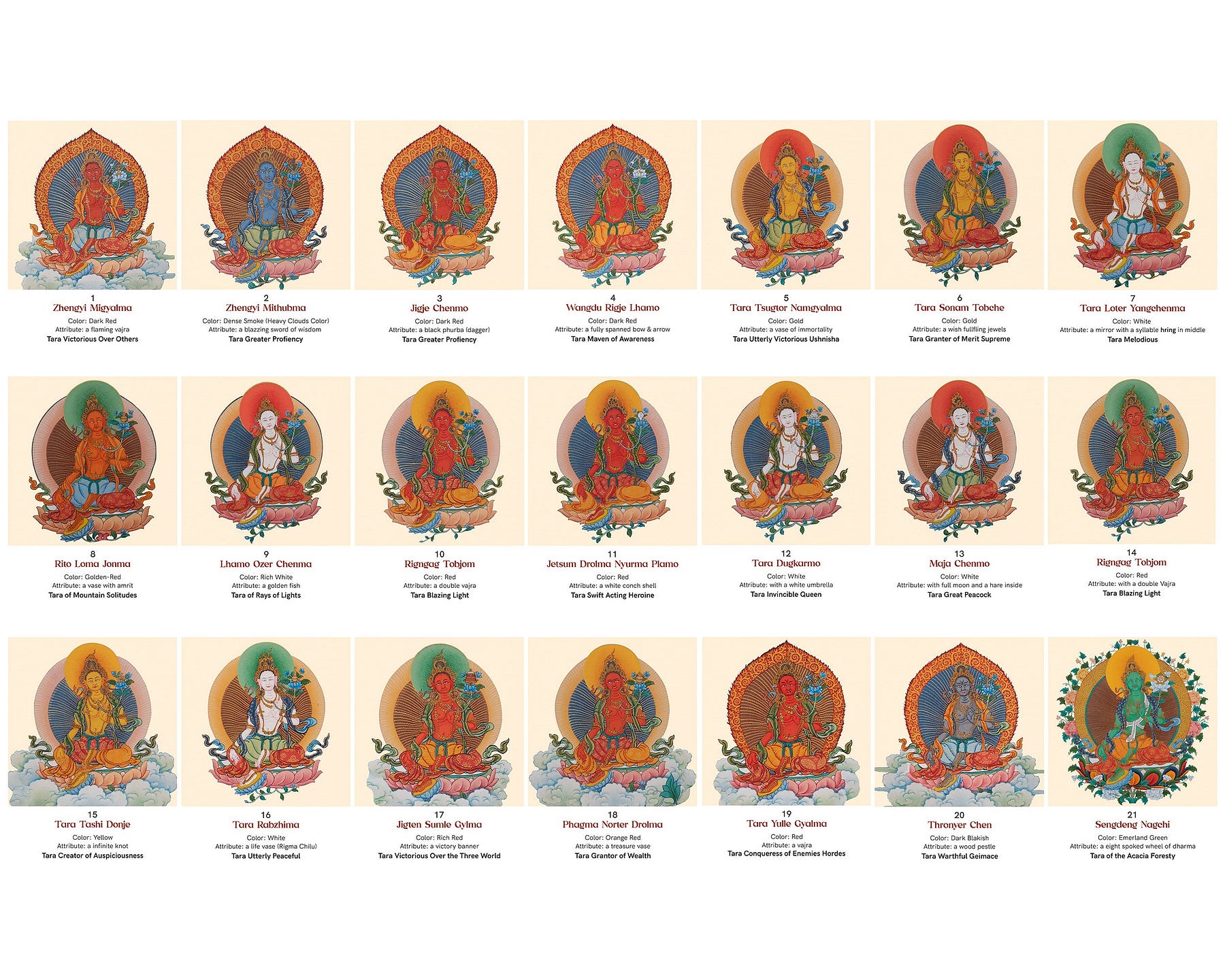
Green Tara (Sengdeng Nagchi): Tara of the Acacia forest
If the 21 Taras were a pantheon, Green Tara would be the founding member. Depicted in vibrant green with one leg extended (ready to leap into action), she embodies active compassion. Her right hand forms the gesture of supreme generosity, while her left holds a blue lotus, symbolizing purity rising from the mud of existence.
Green Tara responds to immediate cries for help. Lost in a forest? Facing sudden danger? Green Tara is the goddess you call. Across the Himalayas, countless stories circulate of travelers protected from avalanches, accidents, and wild animals through her intervention — stories that keep her worship alive and personal.
Nyurma Pamo: The Swift and Courageous
Depicted with a white conch shell on a lotus, this red Tara embodies the awakening of bodhichitta — that compassionate heart-mind that vows to liberate all beings. She is swift in response, courageous in action. When you call her name, she doesn’t hesitate. Her urgency reminds us that compassion cannot wait while beings suffer. She plants the seed of awakening in the heart, transforming ordinary concern into universal commitment.
Loter Yangchenma: The Melodious One
This white Tara’s voice contains all the music of the spheres. She unlocks the treasures of understanding — the four types of knowledge: hearing, contemplating, meditating, and realizing. Students preparing for examinations whisper her name. Writers facing blank pages invoke her blessing. Artists seeking inspiration call upon her. She proves that wisdom and beauty are inseparable — that truth, when fully realized, sings.
Sonam Tobche: Supreme Merit
Holding the dharma wheel, this golden Tara radiates abundance. She accumulates merit — that mysterious spiritual currency creating favorable conditions for awakening. She increases your capacity to help others, multiplying good intentions into tangible results. When practitioners feel their efforts bear no fruit, when generosity seems wasted, Sonam Tobche reminds them: no good deed disappears. All merit accumulates toward liberation.
Tsugtor Namgyalma: Completely Victorious
This white Tara grants longevity — not immortality, but the time needed to complete spiritual work. When children sicken or elders grow frail, her mantra fills Tibetan homes. She pacifies causes of untimely death: accidents, illness, violence. Her victory isn’t over external enemies but over the ultimate interruption — death arriving before awakening.
Wangdu Rigje Lhamo: The Magnetizer (Kurukulla)
This passionate red Tara governs attraction. She draws toward you what you need — not always what you want, but what serves evolution. Need a teacher? She brings one. Lack of resources? She opens doors. Her magnetism works both ways: she makes you attractive to others, giving you charisma to help beings. Red with desire transmuted into spiritual fuel, she proves passion itself can be a path.
Jigje Chenmo: The Terror-Causing
Don’t let her name mislead — she terrorizes only those who would harm you. This red-black Tara holds a blue vase of intoxicating nectar, subduing negative spirits by enchanting them into powerlessness. Invoke her when facing psychic attack, malevolent energy, harmful forces human or otherwise. Her method is elegant: rather than fighting darkness, she intoxicates it with bliss until it forgets its harmful intent.
Zhengyi Mithubma: The Invincible
When storms threaten and lightning splits heaven, this wrathful black Tara shields you. She protects against natural disasters and nature’s destructive forces. Himalayan farmers paint her on barns. Travelers crossing dangerous terrain carry her mantra. She embodies fierce cosmic protection — even chaos bows before awakened compassion.
Zhengyi Migyalma: Triumphant Over Others
Ever been falsely accused? Slandered? This orange Tara specializes in that suffering. She brings victory over enemies who weaponize words. Orange like dawn dispelling darkness, she clears names, reveals truth, ensures false accusations crumble. In courts and conflicts, when truth needs a champion, she appears.
Jigten Sumle Gyalma: Victorious Over Three Worlds
Her name says it all: “Completely Victorious Over the Three Worlds” — desire, form, and formlessness. This red-black Tara holds a blue vase of intoxicating nectar, subduing beings across all dimensions. She recognizes suffering isn’t limited to humans — gods suffer in heavens, spirits in their domains. Her victory is total, her compassion unlimited by any boundary.
Phagma Norter Drolma: The Wealth-Bestower
While some Taras accumulate merit, this yellow-orange Tara actively bestows wealth — material and spiritual. She ensures practitioners never lack necessities: food, shelter, teachings, opportunities. In Buddhist economics, poverty isn’t virtuous if it prevents practice. How can you meditate while starving? How can you study without books? She provides the foundation enabling spiritual life.
Tashi Donje: Excellent Joy
This orange-yellow Tara brings joy — not superficial happiness dependent on circumstances, but deep well-being springing from dharma itself. She creates auspicious conditions, turns situations favorable. When practice becomes grim duty, when the path feels like punishment, she restores the delight that first inspired seeking.
Yulle Gyalma: Victory Over War
In a world torn by conflict, this red Tara stands as peacemaker. She doesn’t just stop external wars — she pacifies hostile emotions creating them. Anger, aggression, the impulse to destroy — she transforms these into peaceful determination. Soldiers pray to her, yes, but so does anyone caught in workplace conflicts, family feuds, or internal battles between competing desires.
Thronyer Chen: The Wrathful Frowning One
Here’s Tara at her fiercest. Scowling with enlightened wrath, this blue-black Tara confronts deep-rooted delusions unresponsive to gentleness. Some obstacles are stubborn; some ignorance clings tight. She brings the nuclear option: wrathful compassion destroying misleading influences at their root. She’s the intervention shattering comfortable illusions we’ve grown too attached to surrender willingly.
Rabzhima: The Peaceful One
After wrath comes peace. Holding rosary, club, lotus, waterpot, and book, this white Tara embodies peaceful purification of negative karma. Every harmful action committed, every hurt caused — she pacifies their consequences. Not by erasing them, but by creating conditions for purification and healing. She is forgiveness personified, the possibility of starting fresh.
Rigngag Tobjom: Blazing Light
Imagine wisdom as blazing fire consuming ignorance like dry grass. This red Tara is that fire — radiant, illuminating confusion’s darkness. She grants insight, sudden understanding reorganizing everything. When study and contemplation leave understanding elusive, she arrives with a flash of recognition. Her light doesn’t just show the path — it reveals you and the path were never separate.
Pagme Nonma: The Unshakeable
Some obstacles try shaking confidence, destabilizing practice, making everything tremble with uncertainty. This red-maroon Tara provides stability — unshakeable ground beneath your feet. She’s the Tara for times of doubt, when the path seems uncertain and commitment wavers. Her strength becomes yours, her stability your foundation.
Tara Maja Chenmo: The Peacock Tara Who Transforms Poison
Drawing on the peacock’s legendary ability to consume poison and transform it into brilliant plumage, this eighteenth Tara specializes in counteracting inner and outer poisons. She transmutes negative emotions into wisdom, harmful substances into healing energy, toxic situations into opportunities for growth. Visualized in pure white — the color of a glacier mountain touched by autumn moonlight — she embodies the alchemical power of transformation.
Tara Dugkarmo: The Unconquerable Queen
Holding a protective umbrella, this white Tara shields against conflicts, bad omens, nightmares. She governs signs and portents, protecting against real dangers and imagined fears alike. When bad dreams disturb sleep, when ominous signs trouble minds, when future-anxiety steals peace — she spreads her umbrella over you, creating a sanctuary where worry cannot reach.
Rito Loma Jonma: Protector from Epidemics
In times of plague and pandemic, her name echoes through temples. Holding medicine in a round vessel, this saffron-yellow-orange Tara dispels epidemics and deadly illnesses. Her protection extends beyond individual healing to communal health — shielding entire populations from disease. In our age of global health crises, her relevance has never been clearer. She reminds us: compassion includes public health; protecting the vulnerable from illness is sacred work.
Lhamo Ozer Chenma: Brilliant Light
The final Tara shines with brilliant light, holding two golden fish symbolizing freedom and abundance of awakening. This white Tara protects life itself — human and animal — granting longevity. She is dawn ending the long night, light at the journey’s end through all 21 stages of spiritual development. Her radiance illuminates the goal: complete liberation for all beings, where every life is precious, protected, and free.
The Wisdom of Multiple Forms
What makes the 21 Taras psychologically brilliant is their recognition that one size doesn’t fit all in spiritual life. A person paralyzed by anxiety needs something different than someone consumed by grief. A student seeking wisdom requires different guidance than someone facing physical danger.
The 21 Taras offer a sophisticated map of human need and divine response. They validate that wherever you are — whatever obstacle blocks your path — there’s a form of compassion specifically calibrated to meet you there.
Modern psychologists might call this “therapeutic matching.” The Buddhist tradition simply calls it wisdom.
Tara’s Revolutionary Promise
In ancient India, where Buddhism originated, a deeply entrenched belief claimed that achieving Buddhahood in a female form was impossible. Women, the doctrine went, must first be reborn as men before attaining enlightenment.
Tara shattered this limitation.
According to legend, when Tara was a princess named Yeshe Dawa (Moon of Wisdom), monks suggested she pray to be reborn male to advance spiritually. Her response was revolutionary: “There is no such thing as ‘man’ or ‘woman,’ no ‘self’ or ‘other.’ These labels are empty.” She vowed to attain enlightenment in female form and to continue manifesting as a woman to liberate beings throughout eternity.
This wasn’t just feminist theology — it was a philosophical bomb that exploded gender essentialism at its core. For millions of women practitioners across Asia, Tara became proof that the highest spiritual achievements were available to them, now, in this very body.
Invoking the Taras Today
You don’t need to be Buddhist to appreciate or work with Tara’s energy. Across the world, people from various backgrounds incorporate Tara practices into their spiritual lives, drawn by her immediate accessibility and practical assistance.
The basic practice is simple: visualization, mantra, and intention. Practitioners visualize the appropriate Tara, recite her mantra (most commonly “Om Tare Tuttare Ture Soha” for Green Tara), and make offerings — even if just a glass of water or a flower. The relationship becomes personal, intimate, a dialogue with compassion itself.
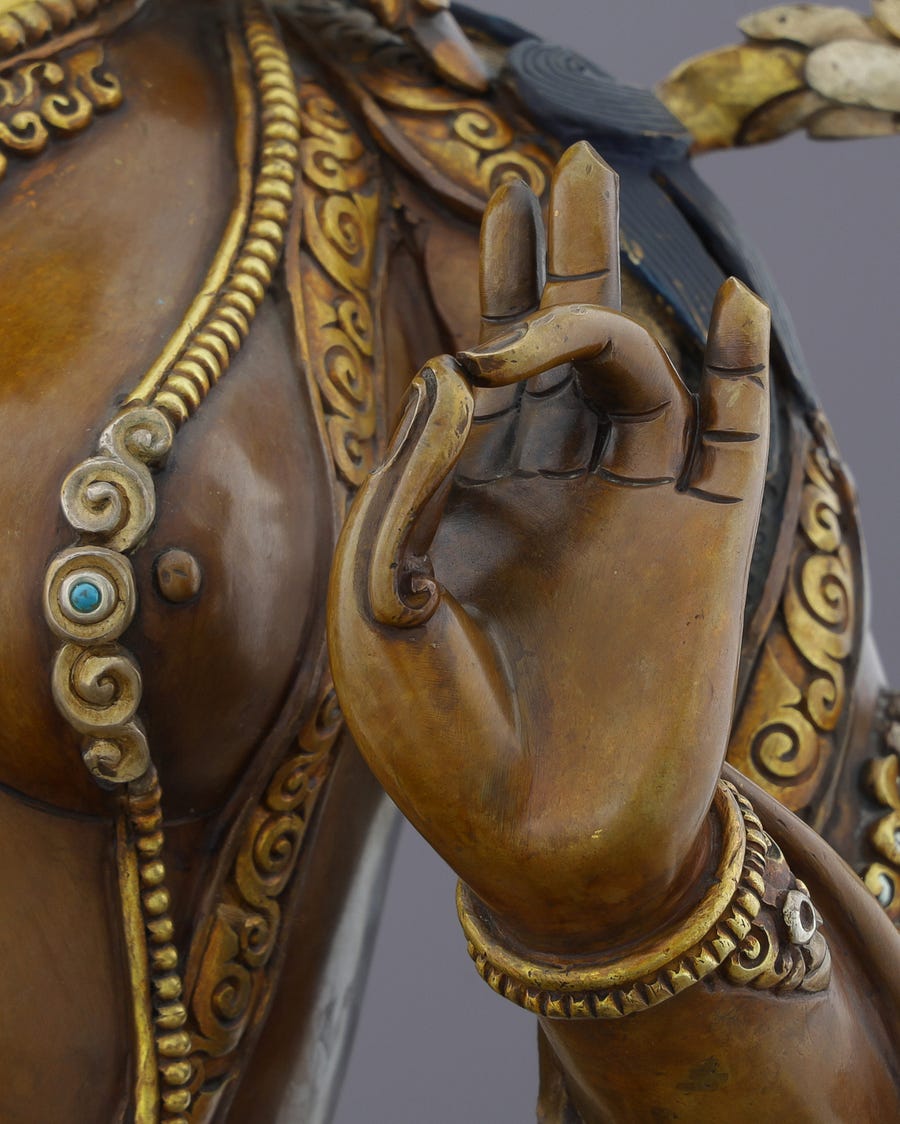
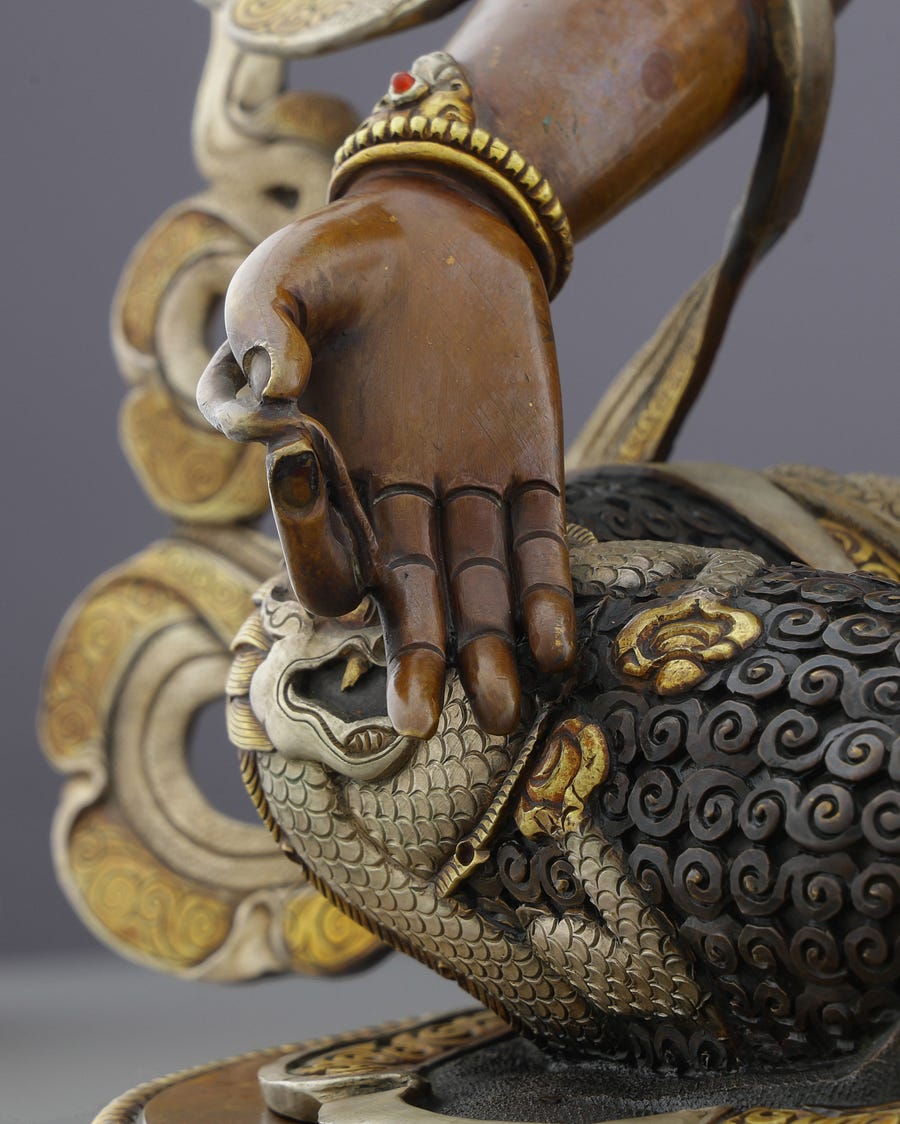
In Tibetan refugee communities from Dharamsala to New York, in Chinese temples from Singapore to San Francisco, in Western convert communities across Europe and America, the 21 Taras continue their work. Mothers teach their children the praises. Monks paint intricate thangkas. Practitioners complete hundreds of thousands of mantra recitations, each one a call for liberation — not just for themselves, but for all beings.
The Deeper Teaching
Behind the colorful iconography and the protective prayers lies Tara’s deepest teaching: compassion is not passive. It doesn’t wait. It doesn’t deliberate. When suffering calls, compassion responds — immediately, appropriately, and in whatever form is needed.
The 21 Taras mirror back to us our own capacity for this kind of responsive love. They suggest that within each of us lies this multiplicity — the ability to be fierce when protection is needed, gentle when healing is called for, swift when action matters, and patient when endurance is required.
Perhaps that’s the real miracle of the 21 Taras. They don’t just save us from external dangers. They awaken us to the vast, versatile compassion already living in our own hearts, waiting to take whatever form the moment demands.
A Living Tradition
The 21 Taras aren’t museum pieces or ancient curiosities. They’re living presences in a living tradition, evolving while remaining rooted in centuries of practice. New Tara forms occasionally emerge through the visions of accomplished practitioners, while traditional forms take on new meanings in contemporary contexts.
When a Tibetan refugee crosses the Himalayas at night, Green Tara walks beside them. When a cancer patient in California begins chemotherapy, White Tara’s healing energy surrounds them. When a student in Mumbai prepares for exams, Yellow Tara opens doors of understanding.
The forms change, the contexts shift, but the promise remains: No one who calls out is beyond the reach of compassion’s many hands.
The 21 Taras remind us that the universe bends toward compassion, that help comes in forms we need rather than forms we expect, and that sometimes, the salvation we seek has already been seeking us — wearing the face we most need to see.
Om Tare Tuttare Ture Soha — Homage to Tara, swift liberator, who saves from every fear.


