

In the foothills of the Himalayas, over 2,500 years ago, a prince walked away from his palace at midnight. He left behind his sleeping wife, his newborn son, and a kingdom that would have been his. What he sought instead would transform not just his own life, but the spiritual landscape of humanity forever.
This is the story of Sakyamuni Buddha — the historical Buddha whose teachings continue to guide millions across the globe today.
Who Was Sakyamuni Buddha?
Sakyamuni Buddha, born as Prince Siddhartha Gautama around 563 BCE in Lumbini (present-day Nepal), was no ordinary spiritual teacher. The name “Sakyamuni” literally means “Sage of the Sakyas,” referring to his Sakya clan, while “Buddha” means “the Awakened One.”
Unlike mythological figures, Sakyamuni was a real historical person whose life journey from privilege to enlightenment offers profound lessons that resonate across cultures and centuries.
The Prince Who Had Everything (Except Answers)
Imagine growing up in a palace where every desire was fulfilled before you even knew you had it. Siddhartha’s father, King Suddhodana, ensured his son experienced only beauty, pleasure, and comfort. He surrounded the young prince with dancers, musicians, and every luxury imaginable.
But why such extreme protection?
A prophecy had declared that Siddhartha would either become a great king or renounce the world to become a spiritual teacher. Determined to secure his son’s future as a ruler, the king built an invisible cage of pleasure around him.
Yet truth, like water, always finds a way through.
The Four Sights That Changed Everything
At age 29, during rare excursions beyond the palace walls, Siddhartha encountered what Buddhists call the “Four Sights”:
An old person, bent with age — revealing that youth fades A sick person, suffering from disease — showing that health is fragile A corpse, being carried to cremation — proving that death is inevitable A wandering ascetic, serene despite owning nothing — demonstrating that peace is possible
These encounters shattered Siddhartha’s sheltered worldview. He realized that suffering (dukkha) touches everyone, regardless of wealth or status. And he became consumed by a single question: Is there a way to transcend suffering?
The Great Renunciation
On a moonlit night, Siddhartha made his choice. He kissed his sleeping family goodbye and rode away from everything he knew. This moment, known as the Great Renunciation, marks the beginning of one of history’s most profound spiritual quests.
For six years, he studied under the greatest teachers of his time. He practiced extreme asceticism, fasting until he was nearly skeletal, pushing his body to the brink of death. But enlightenment remained elusive.
Finally, near collapse, he accepted a bowl of rice pudding from a village girl named Sujata. In that moment, he understood: the path to truth lay not in extreme indulgence or extreme denial, but in the Middle Way.
The Night of Enlightenment
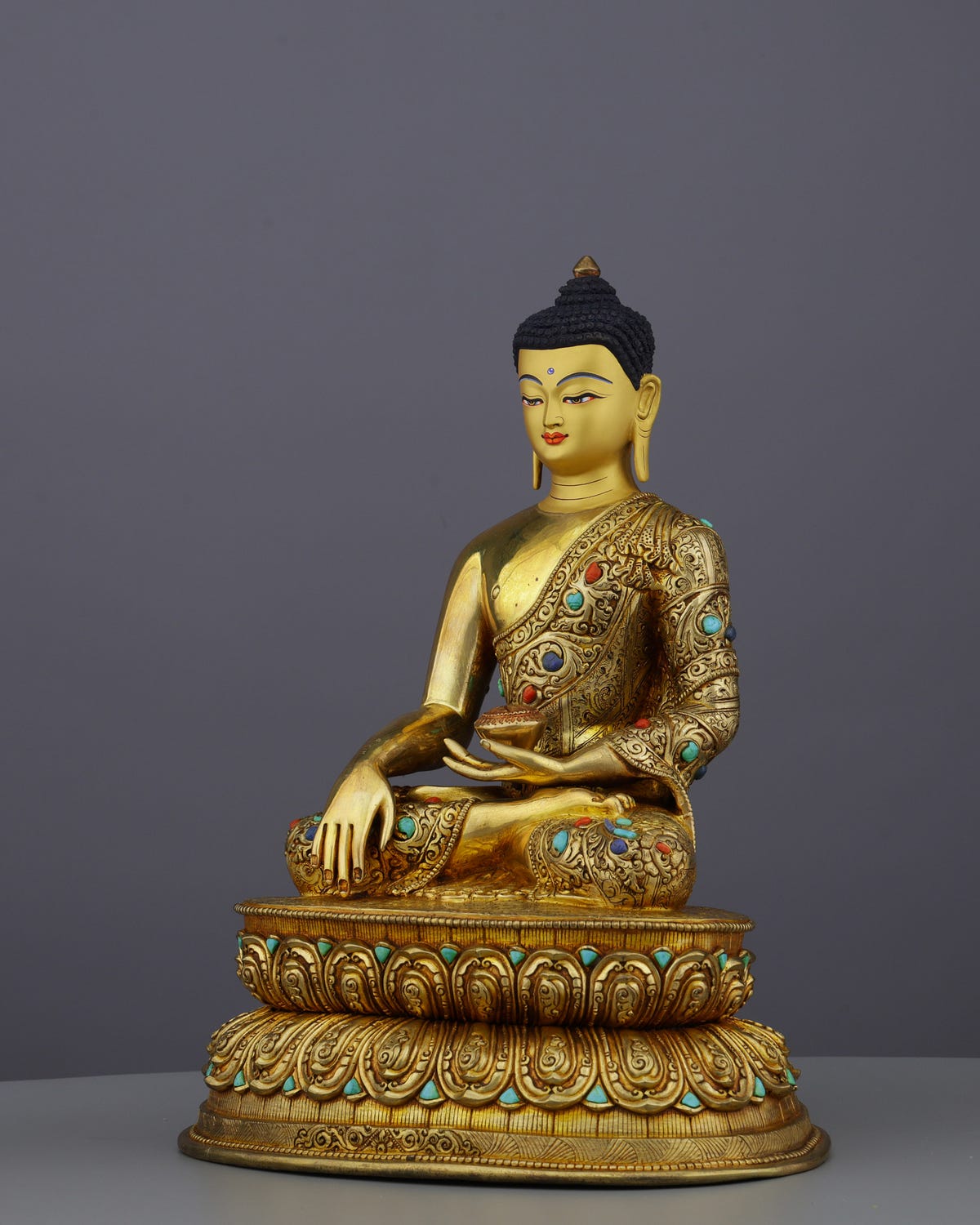
At age 35, Siddhartha sat beneath a Bodhi tree in Bodh Gaya, India, and made a vow: “I will not rise from this seat until I have attained supreme enlightenment.”
Through the night, he meditated deeply. Buddhist texts describe how he faced Mara (the demon of delusion) and his armies of temptation. But Siddhartha remained unmoved, his mind growing clearer and clearer.
As dawn broke, he achieved complete awakening. He understood the nature of suffering, its cause, its cessation, and the path to freedom. Siddhartha Gautama became Sakyamuni Buddha — the Awakened One.
The Core Teachings: Wisdom for the Modern World
What did Buddha discover that night? His teachings, preserved for over two millennia, remain startlingly relevant:
The Four Noble Truths
- Life contains suffering (dukkha) — disappointment, pain, and dissatisfaction are universal
- Suffering has a cause — craving, attachment, and ignorance keep us trapped
- Suffering can end — liberation (nirvana) is possible
- There is a path to the end of suffering — the Noble Eightfold Path
The Noble Eightfold Path
This practical roadmap to enlightenment includes right understanding, right intention, right speech, right action, right livelihood, right effort, right mindfulness, and right concentration.
Unlike commandments, these are not rules but practices — a training program for the mind and heart.
The Middle Way
Perhaps Buddha’s most accessible teaching is the Middle Way: avoid extremes. This applies to spiritual practice, daily life, and even how we view ourselves. Balance, not severity, leads to peace.
Forty-Five Years of Teaching
After his enlightenment, Buddha didn’t retreat into solitary bliss. For 45 years, he walked across northern India, teaching anyone who would listen — kings and beggars, men and women, scholars and criminals.
His first sermon at Sarnath set in motion what Buddhists call “turning the wheel of dharma” — spreading transformative wisdom throughout the world.
He established the Sangha (monastic community), creating a structure that would preserve his teachings long after his death. He welcomed all castes in an era of rigid social hierarchy, declaring that enlightenment was available to everyone, not just the privileged.
Why Sakyamuni Buddha Matters Today
In our age of anxiety, environmental crisis, and digital distraction, Sakyamuni’s teachings offer something rare: practical wisdom that doesn’t require belief in any deity or supernatural realm.
Mindfulness meditation, now scientifically validated for reducing stress and improving mental health, comes directly from Buddha’s teachings.
Compassion practices help us navigate an increasingly divided world with more empathy and understanding.
The concept of impermanence helps us hold our successes and failures more lightly, reducing suffering in an unpredictable world.
Sakyamuni Buddha in Art and Iconography
At Vajra Icon, we honor Sakyamuni’s legacy through authentic Buddhist art and statuary. Each representation carries deep symbolic meaning:
- The Earth-touching mudra (hand gesture) commemorates Buddha’s enlightenment, when he touched the earth to witness his awakening
- The lotus throne represents rising above suffering while remaining rooted in the world
- The ushnisha (cranial bump) symbolizes expanded consciousness
- The urna (third eye mark) represents spiritual insight
These aren’t mere decorations — they’re visual teachings that inspire meditation and reflection.
The Legacy: Buddhism Today
From Tibet to Thailand, Japan to Sri Lanka, Sakyamuni’s teachings have adapted to countless cultures while maintaining their essential wisdom. Today, approximately 500 million people worldwide identify as Buddhists, while millions more practice Buddhist meditation and philosophy without formal religious affiliation.
Modern science continues to validate what Buddha discovered through meditation: that the mind can be trained, that compassion benefits both giver and receiver, and that our perception shapes our reality.
Bringing Sakyamuni’s Presence Home

Whether you’re a devoted practitioner or simply drawn to Buddhist wisdom and aesthetics, a Sakyamuni Buddha statue serves as more than decoration. It’s a daily reminder of our highest potential — to wake up from delusion, to live with compassion, and to find peace amid life’s inevitable challenges.
At Vajra Icon, our collection of Sakyamuni Buddha statues ranges from meditation-sized pieces to impressive altar centerpieces, each crafted with reverence for tradition and attention to iconographic detail.
The Invitation
Sakyamuni Buddha’s final words to his disciples were: “Work out your own salvation with diligence.” He didn’t ask for worship or blind faith. He offered a path and encouraged each person to walk it themselves.
That invitation remains open today. Whether through meditation, study, or simply reflecting on his life and teachings, we can each tap into the same potential for awakening that transformed a confused prince into the Awakened One.
The Buddha nature — the seed of enlightenment — exists within every person. Sakyamuni simply showed us it was there, and pointed the way to its cultivation.


